The Happiness Ripple

Small changes. Better days. Stronger connections.
What if living well is something we can keep learning?
Life keeps changing. Our careers evolve, our families change, our priorities shift, and sometimes, so does our sense of purpose.
The Happiness Ripple is a five-week NUS School of Continuing and Lifelong Education (SCALE) masterclass exploring how we can live well, connect deeply and keep growing at every stage of life.
Drawing on the science of happiness, psychology and human connection, you'll discover practical ways to:
- Understand yourself better
- Build resilience and optimism
- Navigate life's challenges
- Strengthen the relationships that matter
- Create greater meaning and fulfilment
When we change how we think, act and connect, the effect can ripple outward, from ourselves to our relationships, families, workplaces and communities.
Whether you're navigating a career or life transition, leading others, preparing for retirement, beginning a new chapter, or simply looking for greater fulfilment, this masterclass offers space to pause, reflect and discover what could make life better.
Live well. Connect deeply. Keep growing.
5 weeks · 3 hours per week · NUS SCALE Joy of Learning Masterclass
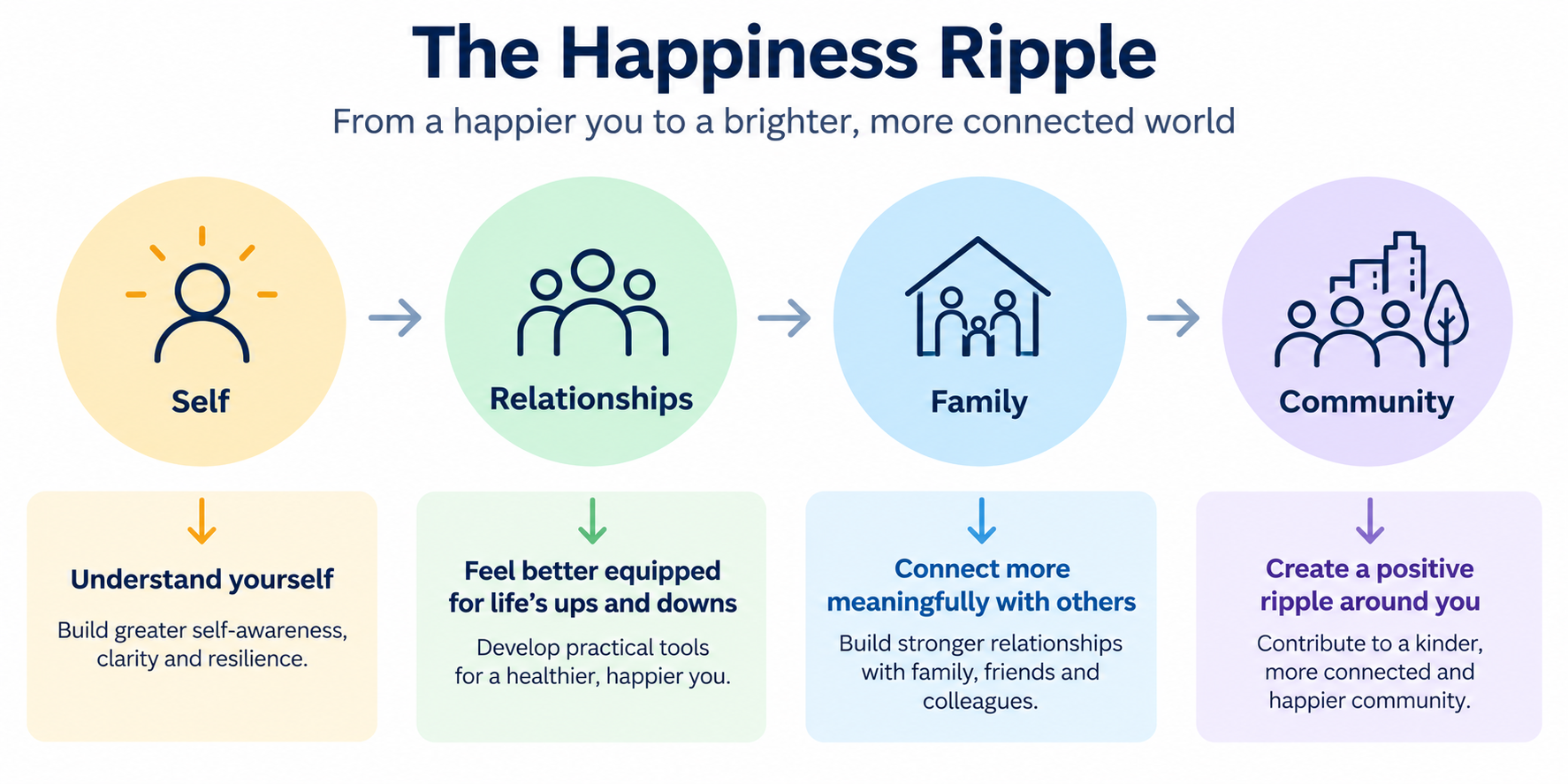
Discover what matters most to you.
Thu, 8 Oct 2026, 9.30am–12.30pm
We spend much of our lives pursuing goals and looking after others. But how often do we stop and ask:
What does a good life mean to me now?
Discover your strengths, values and what gives your life meaning.
You will explore:
- Your personal strengths
- The values you want to hold on to
- Where you are today and what you would like to nurture or change
Takeaway: A clearer picture of what matters to you.
Give yourself something to look forward to.
Thu, 15 Oct 2026, 9.30am–12.30pm
Confidence isn't something we either have or don't have. It can grow.
Hope isn't simply wishing for things to get better. It is about seeing possibilities and finding a way forward.
Whether you are pursuing a new challenge, changing direction or simply doing something you've always wanted to do, discover how to move forward with greater confidence.
You will explore:
- What helps confidence grow
- How to respond constructively to setbacks
- How to turn an aspiration into an achievable plan
Takeaway: A practical plan for something that matters to you.
Build resilience without pretending everything is fine.
Thu, 22 Oct 2026, 9.30am–12.30pm
Life will always have difficult days.
The question isn't whether challenges will come.
It's how we respond when they do.
Discover why our minds naturally focus on worries and problems and learn simple ways to change unhelpful thought patterns and face challenges with greater perspective.
You will explore:
- Why our minds can focus on the negative
- How to recognise unhelpful thought patterns
- Simple ways to reframe difficult situations
Takeaway: Practical tools for life's difficult days.
Because the best conversations can change how we feel.
Thu, 5 Nov 2026, 9.30am–12.30pm
Some of life's most meaningful moments happen in conversation.
With a partner. A child. A friend. A colleague. Or someone you've just met.
Learn how to listen more deeply, ask better questions and be more present with the people around you.
And because this is a practical masterclass, you won't just learn about better conversations, you'll practise them.
You will explore:
- What makes people feel heard and understood
- Simple techniques for better conversations
- How to listen with greater attention and curiosity
Takeaway: Better conversations. Deeper connections.
Create more meaningful relationships, one small moment at a time.
Fri, 13 Nov 2026, 9.30am–12.30pm
Strong relationships are rarely built through grand gestures.
More often, they grow through hundreds of small moments through a phone call, a kind word, a genuine question or simply being there.
Discover how relationships flourish, what can get in the way, and how kindness and generosity can create a positive ripple in the lives of others.
Then return to where you started and see what has changed.
You will explore:
- Everyday opportunities to connect
- Ways to strengthen trust and understanding
- How to respond differently when relationships become difficult
- What you want to carry forward
Takeaway: One or two meaningful changes you can put into practice.
It's five weeks to pause, reflect, discover and connect.
Learn
Explore ideas from psychology, neuroscience and the science of wellbeing.
Reflect
Take time to understand yourself, your experiences and what matters to you.
Practise
Try simple tools and techniques that you can use in everyday life.
Connect
Meet people from different generations and walks of life and learn from their experiences.
Act
Turn what you discover into small changes that can make a real difference.
Happiness is better when it is shared.
Why come alone? Bring someone who matters to you.
❤️ Couples
Discover new ways to understand and connect with each other.
👨👩👧 Parent + Adult Child, Siblings
Learn together and discover perspectives from different generations.
🤝 Friends & Colleagues
Grow together and bring new ideas back into your relationship or workplace.
Take a moment to find out more about the instructors who will be leading the classes.
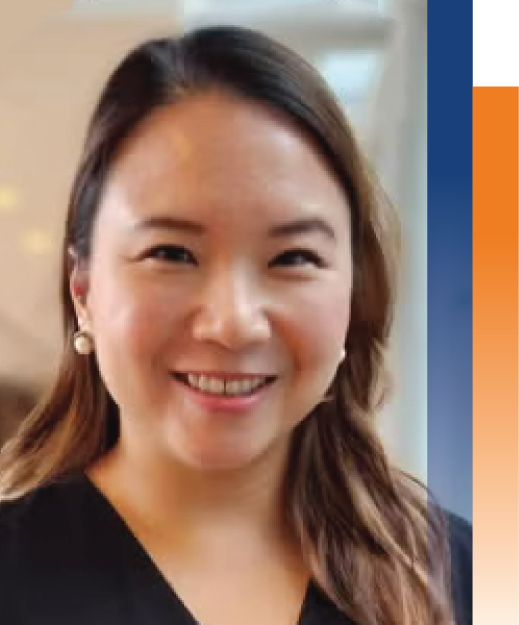
Joanne is a Clinical Psychologist by trade and her experience stems from healthcare and higher education. Her teaching portfolio at NUS has spanned across the design and delivery of modules in clinical psychology, personal and interpersonal effectiveness skills, mental resilience, workplace wellbeing, and occupational psychosocial health. Joanne's current appointment at the unit of Health & Wellbeing, Office of the President, involves leading a team that designs and delivers customised corporate programmes and continuing education and training (CET) programmes. Her mission is to normalise conversations and mindsets about psychological wellbeing and resilience, to create more inclusive and compassionate workplaces.

As a Learning Consultant in the NUS Health & Wellbeing team, Katherine's goal is to help build more inclusive and safe workplaces where employees feel supported and can thrive to reach their fullest potential. With a background in organisational psychology and over 14 years of experience, she has managed, designed and implemented numerous workplace mental health programmes, frameworks and resources across the community and corporate sectors, in a multitude of industries.
The Happiness Ripple (A NUS Joy of Learning Masterclass)
5 weeks · 3 hours per week (8 October–13 November 2026)
To celebrate SCALE's 10th anniversary, we would like to offer learners access to programmes to broaden their perspectives and rekindle the joy of learning. Learners enjoy a special anniversary rate of $200 (before GST) for inaugural runs of courses in the Joy of Learning series (which are usually priced at $1,800 before GST), limited to availability of seats.
The Happiness Ripple Inaugural Run
Dates: Thu, 8 Oct 2026–Fri, 13 Nov 2026
Venue: Education Resource Centre, University Town, National University of Singapore
If you are unable to join the current run of the course, but would like to be notified for upcoming runs, please go to the course web page on the L3AP system, then click "Add to saved courses". You will be notified when the course is next open for registration. Please refer to this guide for more details on how to register your interest.
Click on the button below to find out more!
Come curious. Leave with something practical.

FREQUENTLY ASKED QUESTIONS
Click on the triangles below for more information:
What will this course teach, exactly?
The objective of the course is to show participants that living well is not an innate ability. Research has shown that hope, confidence, resilience and realistic optimism can be developed at any stage of life, and this course will give you a process to do so.
Is class taught lecture style? Will it be very academic?
No. We will be engaging in discussions, exploring real-world cases and doing small group practice. We will also draw on scenarios from life in Singapore.
Will there be practical tips as well as theoretical frameworks?
Yes. We will balance theoretical discussions with immersive, hands-on activities. Participants will develop a profile of their strengths and also a written plan they can follow.
Who will be the other people in this course?
Our participants will come from different walks of life, and different age groups, but all will be interested in understanding themselves better and how to live well.
For more Frequently Asked Questions, click here.
If you have any feedback or suggestions, please drop us a line using the link below!